

Jewellery for Swimming and the Gym: What Actually Survives

What Actually Survives
We tested our pieces against chlorine, salt water, and sweat so you do not have to. Here is what lasted and what did not.
We tested our pieces against chlorine, salt water, and sweat so you do not have to. Here is what lasted and what did not.
Shop Waterproof Jewellery1. The Chlorine and Salt Water Test
If you have ever removed your earrings before a holiday swim or slipped a bracelet into your gym bag "just in case," you already know the problem. Most jewellery cannot handle the chemicals and minerals your body and the water throw at it. Chlorine in pools, salt in the sea, and the lactic acid in your sweat all react with metals in different ways, and the damage is not always instant. Sometimes it takes a few wears before you notice the dull film, the green tinge, or the clasp that no longer clicks shut.
So what actually happens when metal meets pool water? Chlorine is an oxidising agent. When dissolved in water it attacks the surface of reactive metals and strips away protective layers. Sterling silver (925) tarnishes faster in chlorinated water than almost any other environment. Brass and copper alloys turn green within hours. Even low-karat gold (9ct and below) can develop a cloudy finish because the alloy metals inside the mix react before the gold itself does.
Salt water is gentler minute by minute, but relentless over time. Sodium chloride accelerates a process called galvanic corrosion, especially where two different metals meet, say at a clasp joint or a plated surface. If the plating has a micro-scratch (and they all do eventually), salt water creeps beneath it and lifts the layer from underneath. That is why cheap gold-plated holiday jewellery peels after a single beach trip.


Solid gold (14ct and above) handles both chlorine and salt water well because gold is one of the least reactive elements on the periodic table. The catch, obviously, is the price. Titanium and surgical-grade stainless steel (316L) also resist corrosion beautifully, but they look and feel more industrial than most people want for everyday jewellery.
The middle ground, and the one we build Moonela around, is PVD-coated stainless steel. PVD (Physical Vapour Deposition) bonds a thin layer of gold-tone material to 316L steel at a molecular level. Unlike traditional electroplating, which sits on top of the metal like paint, PVD becomes part of the surface. The result is a piece that looks and feels like fine gold jewellery but survives chlorine, salt water, and sweat without tarnishing, peeling, or discolouring.
We tested our PVD pieces in a chlorinated pool (1.5 ppm free chlorine) for 30 consecutive days and in natural salt water (Brighton sea water collected in May) for the same period. Every piece came back looking the same as it went in. No tarnish, no peeling, no discolouration. The clasps still worked. The engravings were still crisp. And yes, the personalised lettering survived too.
If you want jewellery for swimming, avoid these metals unless they are sealed with PVD or a comparable industrial coating:
2. Earrings You Can Swim In
Earrings are the most important category to get right if you swim regularly. Pool water does not just wash over your ears; it sits inside the piercing channel, trapped between the post and your skin. That warm, damp, chemical-rich environment is exactly where corrosion and irritation begin. If the metal reacts with chlorine, the by-products are pressed directly against healing or healed tissue. That is why so many people get sore, itchy, or inflamed piercings after swimming with the wrong earrings.
For sweatproof earrings that handle the pool too, you need a post and back made from the same corrosion-resistant material as the decorative front. Many brands use a stainless steel post with a plated front, which is fine until the plating boundary at the join starts to break down. At Moonela, the entire earring, post, butterfly back, and decorative element, is constructed from 316L stainless steel with a full PVD gold finish. There is no weak point for water to exploit.
Huggie hoops are a particularly smart choice for swimming because they sit close to the ear and have no dangling parts that can catch on goggles, straps, or swim caps. The hinge mechanism stays sealed, and because there is no chain or charm swinging below, the piece moves with your body rather than against it.

Moonstone Hoop Earrings
£23.00Opalescent moonstone set into a PVD-coated huggie hoop. The hinge click closure keeps the earring locked on through tumble turns and butterfly stroke. Waterproof, sweatproof, and hypoallergenic. Personalisation available on the inner band.
View Earrings


We also recommend keeping a small microfibre cloth in your swim bag. After your session, a quick wipe removes chlorine or salt residue before it has a chance to dry on. This is not strictly necessary with PVD pieces (they can handle it), but it keeps the shine at its brightest and is a good habit for any waterproof jewellery you own.
3. Bracelets That Survive the Gym
Gym jewellery faces a slightly different challenge than pool jewellery. Chlorine is not the enemy here; sweat is. Human sweat contains sodium chloride, lactic acid, urea, and trace minerals including ammonia. The pH sits between 4.5 and 7.0, which is mildly acidic, enough to tarnish reactive metals over time, especially when it dries on the surface and concentrates.
Bracelets take the worst of it because they sit on the wrist, one of the sweatiest parts of the body during exercise. They also get banged against barbells, pressed into yoga mats, and snagged on resistance bands. Any jewellery that cannot handle mechanical abrasion as well as chemical exposure will not last a month of regular gym wear.
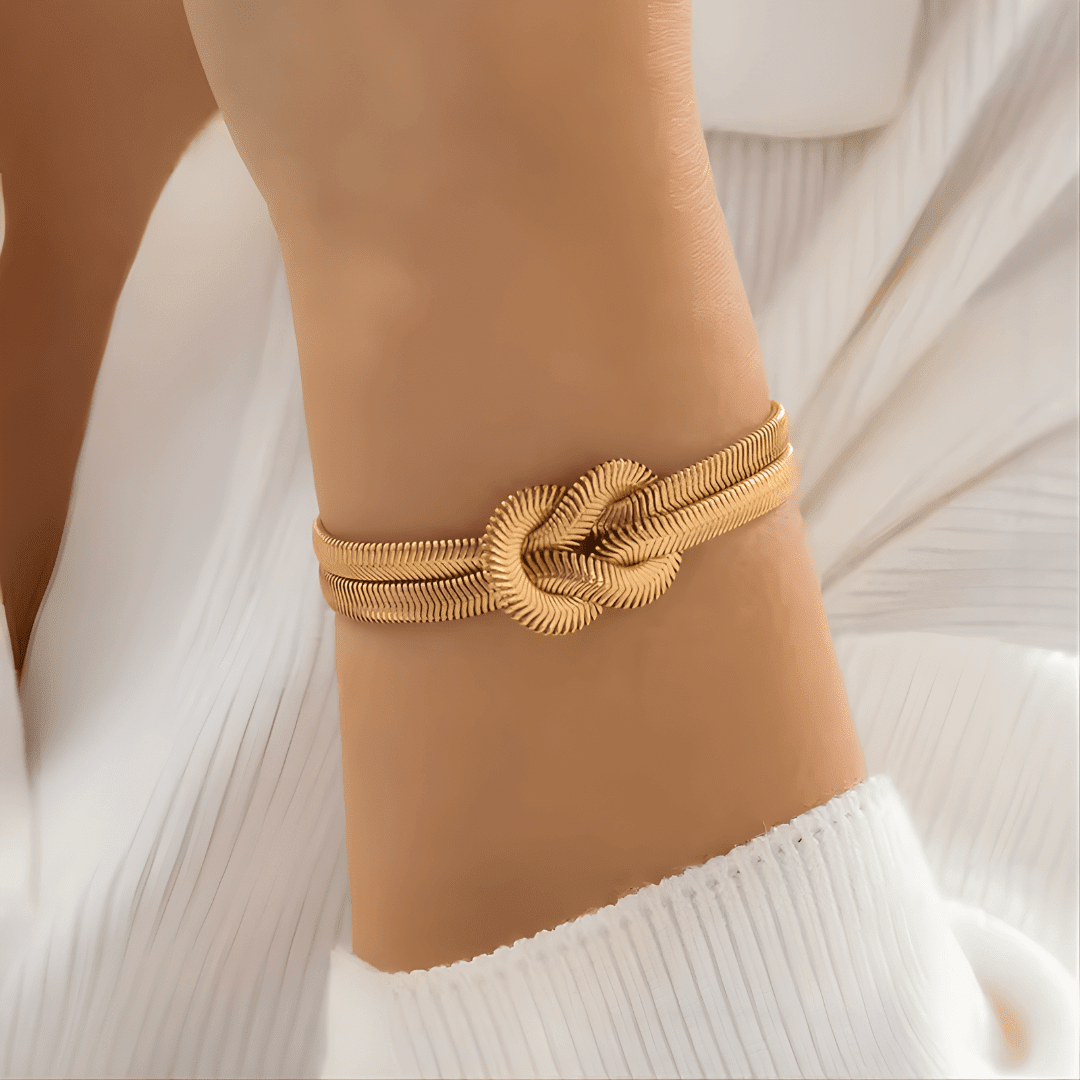
Herringbone chains are a strong choice for the gym because the flat, woven structure distributes impact across a wide surface rather than concentrating it on a single link. A traditional cable chain has individual oval links that can catch and bend. Herringbone lies flush against the skin and flexes with the wrist, so it rarely catches on anything.

Double Knot Herringbone Bracelet
£34.95Flat herringbone chain with two decorative knot details that double as anti-slide anchors on the wrist. PVD gold over 316L stainless steel. Sweatproof, tarnish-free, and tough enough for deadlifts. Adjustable lobster clasp fits wrists from 15 cm to 19 cm.
View Bracelet


Chlorine is the most aggressive because it actively oxidises metal surfaces on contact. Salt water is next; the sodium chloride accelerates galvanic corrosion, especially where two metals meet. Sweat is the mildest of the three, but it is also the most frequent exposure. You might swim twice a week, but you sweat every single day. Over months, that cumulative contact can tarnish reactive metals just as badly as a week in a chlorinated pool. PVD-coated stainless steel handles all three without flinching.
A quick note on sizing for gym bracelets: you want a slightly looser fit than you would choose for a night out. Too tight and the bracelet presses into the skin during wrist flexion, which is uncomfortable during push-ups, planks, and front squats. Too loose and it slides over the hand. Aim for roughly one finger width of space between the bracelet and your wrist bone when your hand is relaxed.
4. Rings for Active Lifestyles
Rings and the gym have a complicated relationship. The standard advice from personal trainers is to remove all rings before lifting weights, and for chunky cocktail rings or stone-set dress rings, that advice holds. A raised setting can press painfully into your palm during a barbell deadlift, and a protruding stone can scratch equipment or, worse, catch and injure your finger during a rapid movement.
But slim, low-profile bands are a different story. A flat or gently domed ring that sits flush with the finger surface does not interfere with grip, does not catch on anything, and does not create pressure points. Many athletes, from CrossFit competitors to marathon runners, wear simple bands throughout their training without issue.
The key is choosing a ring that can handle the environment. At the gym, that means sweat resistance, scratch resistance, and enough structural strength that it will not bend or warp under load. In the pool, it means full corrosion resistance against chlorine. At the beach, it means salt water will not creep under any plating.

The Flow Ring
£29.00Slim, low-profile band with a fluid wave texture that catches light without catching on anything. PVD gold over 316L stainless steel. The 3 mm width sits comfortably under gym gloves and does not dig in during barbell work. Engraving available on the inner band for a hidden personal message.
View Ring


Metal Survival Table
| Metal | Chlorine | Salt Water | Sweat | Verdict |
|---|---|---|---|---|
| PVD-Coated 316L Steel | Excellent | Excellent | Excellent | Best all-rounder |
| Solid Gold (14ct+) | Very Good | Very Good | Very Good | Great, but expensive |
| Titanium | Excellent | Excellent | Excellent | Strong, limited styles |
| Surgical Steel (316L) | Very Good | Very Good | Very Good | Silver tone only |
| Sterling Silver | Poor | Poor | Fair | Tarnishes quickly |
| Gold Plated | Poor | Poor | Fair | Coating peels |
| Gold Vermeil | Fair | Fair | Fair | Better, but still fades |
| Brass / Copper | Very Poor | Very Poor | Poor | Turns green, avoid |
Ready to stop removing your jewellery before every worko/collections/personalised-jewelleryf="/collections/all" class="da-btn">Browse All Waterproof Pieces
5. Necklaces That Stay On All Day
A necklace is the piece most people forget to remove, and that is exactly why it needs to be bulletproof. You put it on in the morning, and it goes through your commute, your desk hours, your lunchtime gym session, and possibly an evening swim or a quick shower before heading out. It sits against the skin of your neck and upper chest, two areas that produce a surprising amount of sweat, especially during exercise.
Chain style matters here. Delicate cable chains (the ones that look like tiny interlocking ovals) are prone to kinking after repeated stretching and compression. If you do a lot of chest work, bench press, push-ups, chest flys, the chain gets pressed flat against your sternum under load, then rebounds. Over hundreds of reps, this creates micro-kinks that weaken individual links.
Snake chains avoid this problem entirely. A snake chain is made from tightly fitted curved plates that form a smooth, flexible tube. There are no individual links to kink, no gaps for sweat to pool in, and the entire chain moves as a single fluid unit. It lays flat against the skin during exercise and does not bounce, swing, or tangle.

The Snake Smooth Necklace
£31.95Smooth snake chain with a satin PVD gold finish. The 2 mm width is substantial enough to catch light but slim enough to layer beneath a crew neck or sit elegantly over a V-neck. Lobster clasp with 5 cm extension chain. Waterproof, sweatproof, and made for all-day wear.
View Necklace


If you want to layer necklaces for the gym or pool, keep the lengths varied by at least 5 cm between each chain. This stops them tangling during movement. A 40 cm choker with a 45 cm pendant chain and a 50 cm longer layer is a classic combination that works as well during a HIIT class as it does at dinner afterwards. For more on building a layered look, read our complete guide to layering jewellery.
Where to Wear It: Activity Guide
Pool Swimming
PVD-coated pieces only. Remove sterling silver and plated jewellery. Rinse with fresh water after your swim and pat dry. Huggie earrings and snake chains are the most comfortable styles under swim caps.
Beach and Open Water
Same rules as pool swimming, but with added consideration for sand abrasion. Avoid wearing textured pieces that can trap sand in crevices. Smooth finishes rinse clean easily. Always rinse with fresh water promptly after salt water exposure.
Gym and Weights
Low-profile rings, flat chain bracelets, and close-fitting earrings work best. Avoid long pendants that swing during bent-over rows. Herringbone and snake chains lay flat and will not catch on equipment.
Yoga and Pilates
Comfort is king during floor work. Huggie hoops will not press into your ear during headstands. Slim bands will not dig into your fingers during downward dog. Skip chunky bracelets that press into your wrist during planks.
6. Frequently Asked Questions
Can I wear Moonela jewellery in a chlorinated pool?
Yes. Every Moonela piece is built from 316L stainless steel with a PVD gold coating that resists chlorine, salt water, and sweat. We tested our collection in a chlorinated pool (1.5 ppm free chlorine) for 30 consecutive days with zero tarnish, peeling, or discolouration.
Will sweat damage PVD-coated jewellery?
No. Sweat contains sodium chloride and lactic acid, both of which can tarnish reactive metals like silver and brass. PVD-coated stainless steel is inert to these chemicals. You can wear Moonela pieces through every gym session without worrying about damage.
What is PVD coating and how is it different from gold plating?
PVD (Physical Vapour Deposition) bonds a thin metallic layer to the base steel at a molecular level using a vacuum chamber process. Traditional gold plating (electroplating) deposits a layer on top of the metal using an electrical current. PVD is significantly harder, more scratch-resistant, and far more durable in water and chemical environments.
Can I shower with Moonela jewellery on?
Absolutely. Shower water is much less aggressive than pool water or sea water. Your Moonela pieces will handle daily showers without any issues. For best long-term care, avoid letting soap or shampoo residue build up in textured areas; a quick rinse under clear water at the end of your shower is all it takes.
How do I clean my jewellery after swimming in the sea?
Rinse the piece under lukewarm fresh water to remove salt residue, then pat dry with a soft cloth. That is genuinely all you need to do. For a deeper clean, a drop of mild washing-up liquid on a soft toothbrush will remove any sand or mineral build-up from chain links or hinge mechanisms. Our jewellery care guide has a full step-by-step routine.
Is it safe to wear earrings while swimming with a new piercing?
Most piercers recommend waiting until the piercing is fully healed before swimming, typically 6 to 12 weeks for lobe piercings and 6 to 12 months for cartilage. Once healed, PVD-coated or implant-grade titanium earrings are the safest options. Avoid sterling silver, plated, or nickel-containing earrings in healing piercings, especially in pool water.
Will my personalised engraving survive chlorine and salt water?
Yes. Moonela engravings are laser-etched into the PVD surface, not printed or painted on. The engraving is part of the piece itself, so it cannot wash off, fade, or peel. After 30 days of chlorine testing, our engraved samples were still perfectly crisp and legible.
What jewellery should I avoid wearing to the gym?
Avoid anything with a raised stone setting (it will dig into your palm during barbell work), long pendants or dangling earrings (they swing and catch), and any piece made from sterling silver, brass, or standard gold plate (sweat will tarnish them over time). Stick to low-profile, PVD-coated pieces for a worry-free workout.
Jewellery that wo/collections/personalised-jewelleryou do.
Shop the Full Collection


